Never Argue With The Instructor
Never argue with the instructor - except…
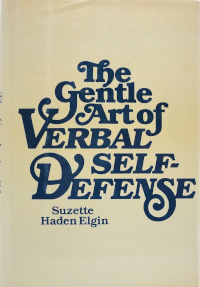
I’ve just been reading “The Gentle Art of Verbal Self-Defense” by Suzette Haden Elgin. And I’ve been reading it slowly and carefully, making notes.
Part of the reason for this is that I’ve also been reading “The Notebook: A History of Thinking on Paper” by Roland Allen. And one of the things that I realised from reading that book is that I gained one piece of actual wisdom from my university education. This is that piece of wisom. Ready? For certain subjects (I studied philosophy), it’s much more important to understand one or two books very well rather than reading lots of books. This of course also fits with prioritising spending most of your time hanging around with your mates and watching afternoon TV and recovering from hangovers.
Stay with this - the philosophy is relevant. I assure you. The philosophy is relevant. At least for this story.
“Never argue with an instructor in front of other students or other faculty or other anybody. (The only exception is the rare case in which it really is a matter of principle.)” Suzette Haden Elgin
This is a bit of a problem for me. Because one of the foundational stories of my life involved arguing with an “Instructor.” It’s how I met one of very best friends - best man at my wedding. That’s it, it’s a meet cute story.
You might think that interdisciplinary courses are a good idea. Interdisciplinary Masters courses - you might think they’re a good idea. The people who attend them see things from a different point of view, they see things using a different paradigm. But of course, seeing things differently and from a different point of view, and using a different paradigm leads to conflict. Like the cartoon of the man pointing at the figure on the floor and shouting that it’s a nine! And the woman looking at it from a different point of view and claiming that it’s a six!
“What do we know about knowledge?”
Meta enough for you? This was a “Data Structures” lecture. The multidisciplinary Masters was “Cognitive Science” a mix of psychology, linguistics, philosophy and computer science.
“It’s true.” I paid attention in epistemology - the study of truth. Yes, of course, it’s more complicated than that. There is isn’t just “knowing that” there is also “knowing how.” And there are some tricksy buggers, like Wittgenstein, who are maybe trying to say that all “know that” is in fact “knowing how.” That knowing anything is really just skillful and correct application of language. But for Masters level, surely it isn’t that controversial to say that we can only know true things.
But here’s where the trouble starts. The “Instructor” wasn’t happy with this answer.
“Not necessarily.” “Not necessarily? Can you give me some examples of things that we can know that aren’t true? We can’t know that 2 + 2 = 5. We can believe it, but knowledge being justified true belief, knowing that 2 + 2 = 5 would be wrong on two counts. The first problem it’s not true. The meanings of “2”,”+”,”=” and “5” mean it can’t be true. And the second problem is that it can’t be justified because it’s not true!”
If I’m honest, I don’t recall the rest of the dialogue. But what I do remember is that in the crowd of people around the seminar room of people looking at me as if I was being a dick (I was, I will admit it now, being a dick) was a man with a big nose who was nodding and smiling. And I remember it crossing my mind at that point, that maybe we would be friends. And we were.
But, as the man in a training course where I was the instructor, once asked - when I asked him to walk around the seminar room pointing at things and saying what they’re not - “Is there a point to his exercise.”
Here’s the point to this exercise. I think Haden Elgin’s advice is generally good. Actually, no I don’t. Now I’ve written it down. I realise I don’t think that. Argue with your instructors. They are probably trying to tell you some old bullshit like the idea that knowledge can be false.
And you might just make a friend.